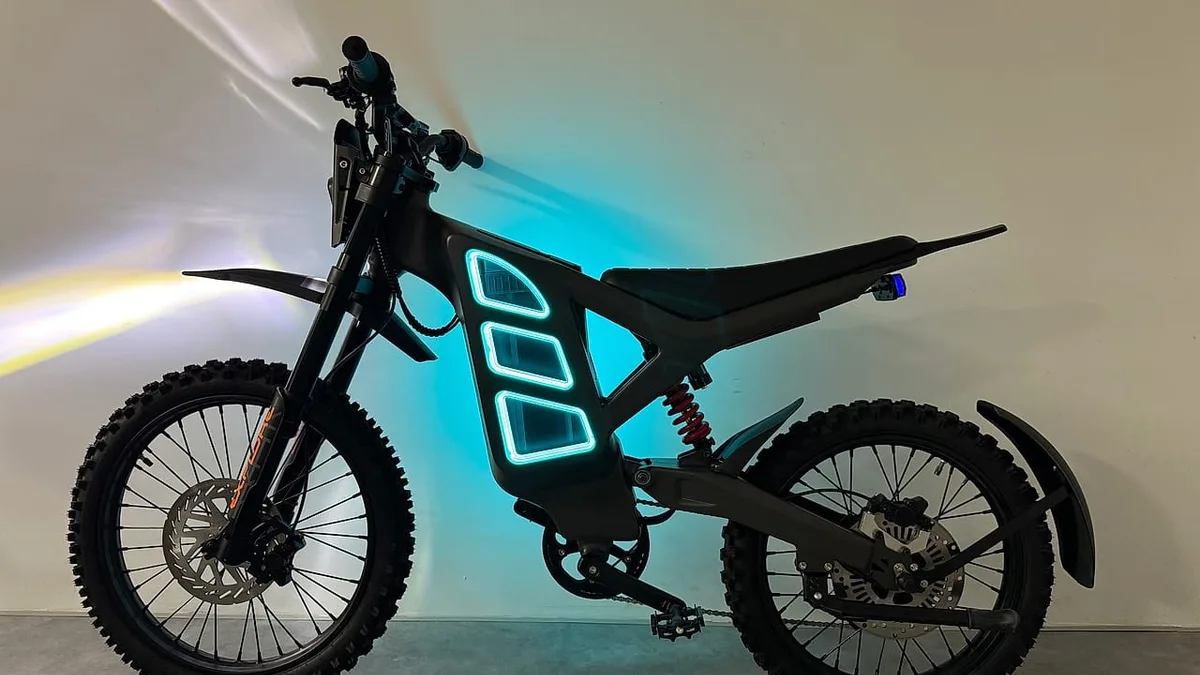
You already move parts, accessories, or maybe analog bikes, and now you're looking at electric off road bikes for sale as the next line item on your distributor P&L. The question isn't whether the category is real—it is—but which SKUs to stock, what to test before you commit a container, and what to negotiate with the factory so the margin survives freight, duties, and warranty claims. This playbook is written for the established distributor adding e-bikes or a new sub-category, not for a first-time importer buying one sample.
Start with the product mix, because off-road e-bikes are not one category. You have fat-tire hardtails, full-suspension trail bikes, and utility/ cargo-adjacent off-roaders, and each behaves differently in your market. A 26" fat-tire bike with a 750W rear hub and a 48V 15Ah battery is the volume play for CIS and African markets where roads are rough and service is simple. A mid-drive 250W/500W full-suspension model is the European play, but it drags in EN 15194 compliance and a higher landed cost. For a first container, I'd suggest 60–70% fat-tire hardtails, 20–30% mid-drive trail, and a small test allocation of cargo or long-tail. Look at the JIUYUE GT600-20 Pro as a reference point for the fat-tire volume slot—20" wheels, a robust frame, and a spec sheet that survives distributor-level abuse. Don't stock five frame sizes of one model; stock two sizes and three colors, and let the factory hold the rest.
What to test before you scale is where most distributors get burned. Ask the factory for a pre-production sample and run it 300–500 km yourself or through a local test rider. Check the controller heat under sustained load, the battery BMS cut-off behavior, the torque sensor if it's a mid-drive, and—critically—the spare parts availability for that exact model. A common buyer question on Reddit and LinkedIn is: "What MOQ should I expect from a real factory?" For a private-label off-road e-bike, a realistic MOQ is 50–100 units per model/color combination, and 20–30 units if you accept stock colors and the factory's existing frame. If a supplier quotes you MOQ 5 with custom branding, they're either a trading company or they're about to substitute components. Test the after-sales loop too: order a spare controller, a display, and a battery for your sample and time how long they take to arrive. If spares take six weeks, your warranty cost will eat the margin.
Negotiation is where the distributor playbook actually pays off. Don't negotiate only on unit price—negotiate on the landed cost stack. Ask for the FOB price broken down by motor, battery, frame, and assembly, then ask what changes if you switch from a 48V 13Ah to a 48V 20Ah pack. Battery is typically 30–40% of the BOM, so that's your biggest lever. Negotiate a spare-parts kit at 2–3% of order value, a 12-month warranty on the frame and 6–12 months on the battery with a clear capacity-retention threshold (usually 70%), and a written commitment on lead time. Realistic lead time for a 100–200 unit order is 35–50 days production plus 25–40 days sea freight to most CIS, Middle East, and African ports. If you're shipping to the EU, add EN 15194 and CE documentation, and confirm who holds the technical file—the factory or you. That single question separates a serious supplier from a reseller.
Industry context matters more than most distributors admit. The factory landscape is concentrated in Tianjin, Wuxi, and Shenzhen, and the good off-road factories are the ones already shipping to Europe or North America because their frames and battery packs have been tested. Ask for test reports, not brochures. On the policy side, the questions buyers actually type into Google are telling: "Do I really need UL 2849 to sell e-bikes in the US?" Yes, for most retail channels and increasingly for insurance; UL 2849 covers the electrical system, and UL 2271 covers the battery. For the EU, EN 15194 is the baseline and EN 17128 applies to some lighter vehicles. Duties vary: e-bikes into the EU attract anti-dumping duties depending on origin and HS code, and into the US Section 301 tariffs apply to Chinese-origin e-bikes. Build a landed-cost model before you sign, and don't assume the factory's quoted price is your cost.
A second product reference worth putting on your test bench is the JIUYUE X5 Pro—a mid-drive off-road platform that lets you compare torque-sensor feel and frame stiffness against your hub-drive volume SKU. Use it to decide whether your market is ready for a higher-ticket trail bike or whether you should stay in the fat-tire lane for another season. The point isn't to stock everything; it's to test one step up from your volume model so you learn what your dealers can actually sell. Pair that with an accessories plan: spare chargers, a rack option, and a second battery SKU are the three add-ons that turn a bike sale into a repeat customer. Distributors who stock a spare battery for every model they sell report far fewer warranty disputes, because the dealer can swap and diagnose instead of shipping the whole bike back.
Closing takeaway: treat electric off road bikes for sale as a category you build in phases—volume fat-tire first, one mid-drive test SKU, a spares kit negotiated into the first PO, and a landed-cost model that includes certification and duties before you commit. Get the sample, the spares, and the warranty terms in writing, and the category becomes a repeatable line rather than a one-container gamble.