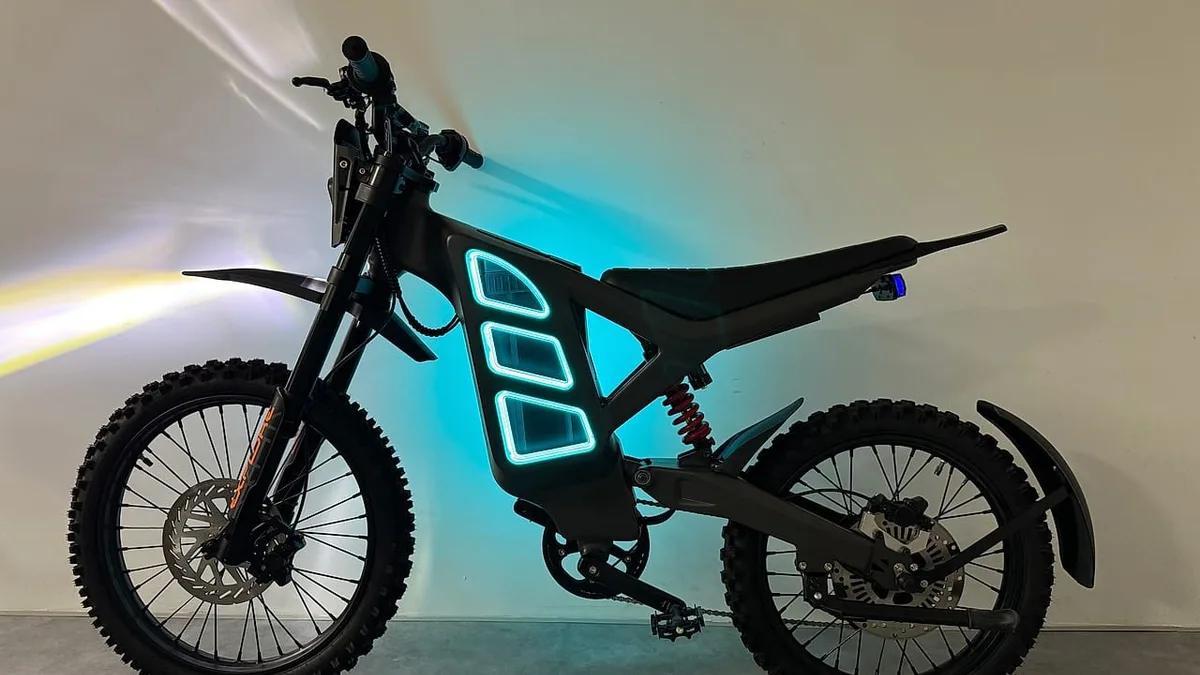
When you search for an electric dirt bike for sale, the sticker price is only half the story. The other half lives in a container yard, on a bill of lading, and in the fine print of a freight forwarder's quote. I've seen buyers get excited about a $680 FOB unit only to discover that poor packing and the wrong port choice added $190 per bike in landed cost. This article is about that gap — the unglamorous logistics that decide whether your margin survives the journey from factory floor to your warehouse.
## Container math: how many bikes actually fit, and why it matters
The first question every serious importer asks is: how many units fit in a 40HQ? For a standard electric dirt bike with a 17-inch front wheel and a 14-inch rear, you're typically looking at 60–75 units per 40HQ if the factory knows how to pack — frames nested, front wheels removed, handlebars folded, batteries boxed separately in UN38.3-compliant packaging. A model like the JIUYUE GT600-20 Pro, with its 60V 20Ah removable pack and 12-inch rear wheel, can sometimes be packed 80 units per 40HQ when the battery is shipped in a separate carton and the front end is partially disassembled. That's a 20–30% swing in per-unit freight cost versus a lazy pack. Ask your supplier for a loading plan with photos before you book. If they can't produce one, they've never optimized for export.
## Lead times and port choices: the hidden cost of "cheap" routing
A realistic production lead time for a container of electric dirt bikes is 25–35 days after deposit and artwork approval, plus 7–10 days for booking and trucking to port. But the port you choose changes everything. Shipping from Ningbo to Jebel Ali is fast and predictable; shipping from a smaller inland port to a secondary African port can add two weeks and a transshipment risk. For CIS buyers, rail via Khorgos is often cheaper per CBM than sea-to-Novorossiysk, but the schedule is less flexible. For South America, Santos and Cartagena are the workhorses, but congestion fees can add $300–$600 per container. I've seen buyers save $40 per bike by switching from a premium direct service to a slower consolidated route — and lose it all in demurrage when the container sat for 11 days at destination.
## Packing, batteries, and the certification trap
Batteries are the single biggest logistics headache. A 60V 20Ah lithium pack is Class 9 dangerous goods; it must ship with UN38.3 test reports, a MSDS, and often a UN38.3 summary. Some carriers refuse loose batteries entirely, so factories ship them inside the bike frame or in a separate certified carton. This is where certification intersects with freight: if you're selling into the EU, you need CE and EN15194 documentation; into the US, UL 2849 is increasingly demanded by retailers and insurers. A common buyer question is: "Do I really need UL certification to sell in the US?" Strictly speaking, federal law doesn't require it for all e-bikes, but major retail chains and many state incentive programs do — and without it, your container may sit in a warehouse while you scramble for testing. Budget 6–10 weeks and $3,000–$8,000 per model for UL 2849, and factor that into your landed cost before you commit to a purchase order.
## Accessories, spare parts, and the MOQ question
Another common buyer question: "What MOQ should I expect from a real factory?" For electric dirt bikes, a realistic MOQ is one 20GP (about 30–35 units) for a stock model, or 50–100 units for custom colors and branding. But the smarter play is to bundle spare parts into the same container: chargers, controllers, throttle assemblies, spare battery packs, and a few complete wheel sets. A spare 60V 20Ah battery adds maybe $180 to your cost but saves you a $400 air-freight emergency when a customer's pack fails. Factories like JIUYUE will often include a small spare-parts kit at no charge if you ask during negotiation — but you have to ask. Also consider accessories that increase average order value: upgraded headlights, cargo racks, and off-road tires. These are cheap to add at the factory and expensive to source locally.
## Duties, import rules, and the landed-cost spreadsheet
Landed cost is not FOB plus freight. It's FOB plus freight plus insurance plus duty plus VAT plus port fees plus inland delivery plus a contingency for demurrage. Duty rates vary widely: the EU commonly applies 6–14% on e-bikes depending on classification and origin; the US has Section 301 tariffs that can push total duties on Chinese-origin e-bikes into the 25–50% range; GCC countries often apply 5%; Mercosur countries can be 20% or more. If your factory can ship from a Vietnam or Thailand facility, you may qualify for different rates — ask. And always get a landed-cost calculation from your forwarder before you sign. A $700 FOB bike can land at $1,050 or $1,300 depending on routing, duty, and packing. That difference is your entire retail margin.
Closing takeaway: before you wire a deposit for any electric dirt bike for sale, demand a loading plan, a UN38.3 battery report, a landed-cost quote from your forwarder, and a written lead time with penalties. The factory that answers all four clearly is the one worth your container.